

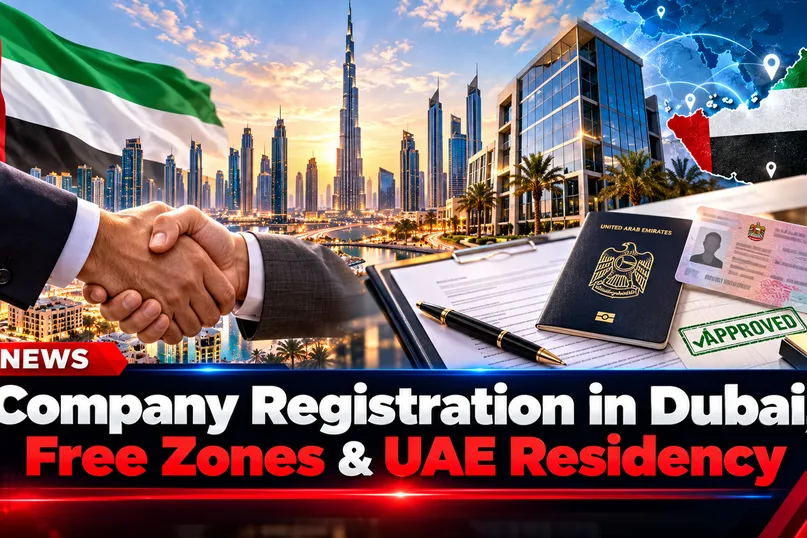
The UAE remains one of the most attractive jurisdictions for entrepreneurs, investors, consultants and international founders who want to establish a business and secure legal residency in the region. In 2026, one of the most practical routes is UAE company formation followed by a residence visa application linked to the licensed business.
- Can company formation lead to UAE residency?
- Dubai Mainland company formation
- Why UAE free zones remain popular with international founders
- Meydan Free Zone: flexible Dubai setup with a two-year investor visa route
- SPC Free Zone: Sharjah setup with streamlined residency processing
- JAFZA: a strategic option for trade, logistics and larger operations
- What is normally required after company incorporation?
- Company ownership and UAE residency are not the same thing
- Mainland, Meydan, SPC or JAFZA: which one is better?
- Special opportunities for international entrepreneurs
- Key takeaway
This route is available through both Dubai mainland company registration and a wide range of UAE free zones. The best structure depends on the planned business activity, target market, office requirements, number of visa allocations, banking needs, ownership structure and long-term expansion plans.
Can company formation lead to UAE residency?
Yes. After a qualifying UAE company is incorporated and the relevant immigration file or establishment card is activated, an eligible shareholder, investor, partner or employee can generally proceed with a residence visa application. The process usually includes an entry-status step where applicable, medical fitness screening, Emirates ID registration and immigration processing.
For many free-zone business setups, the common residence-visa validity is two years and renewable, provided the sponsoring company remains active and compliant. This is particularly relevant to founders considering Meydan Free Zone or SPC Free Zone. However, visa validity is not identical across every authority: JAFZA currently publishes separate guidance under which shareholder and employee residence permits may be valid for three years.
For founders who want a business and residency package tailored to their activity and nationality, UAE residency and company setup support can help compare the available routes before incorporation.
Dubai Mainland company formation
A Dubai mainland company is generally suitable for businesses that want broad access to the local UAE market, direct commercial activity in Dubai, physical premises where required, and the flexibility to serve private-sector and eligible government clients under the applicable licensing rules.
Mainland structures can be appropriate for consulting, trading, professional services, retail, contracting and many other activities. Depending on the activity, additional approvals may be required from sector regulators. Office and tenancy requirements also differ from many free-zone packages, so founders should compare the total operating cost rather than only the initial licence fee.
Why UAE free zones remain popular with international founders
UAE free zones are popular because they can offer streamlined incorporation, 100% foreign ownership for eligible activities, remote setup options, flexible office solutions and integrated immigration services. Many founders use a free zone company in the UAE as a practical entry point for regional operations, consulting, e-commerce, international trade, technology, media and professional services.
Three widely considered options are Meydan Free Zone in Dubai, SPC Free Zone in Sharjah and Jebel Ali Free Zone (JAFZA) in Dubai. Each serves a different business profile.
Meydan Free Zone: flexible Dubai setup with a two-year investor visa route
Meydan Free Zone is a Dubai-based free zone designed around digital incorporation and relatively flexible company setup. Current Meydan guidance states that founders can establish a company remotely, choose from a large range of business activities and later add visa services after incorporation.
Meydan also states that qualifying business owners can apply for an investor or partner residence visa after the company is formed and the immigration profile is active. Its investor visa route is typically valid for two years and can be renewed while the company licence remains active and immigration requirements continue to be satisfied.
Another advantage is flexibility: founders may begin with a zero-visa setup and add residence eligibility later, depending on their package and operational plans. For entrepreneurs who specifically want a Dubai address and a fast digital setup, Dubai free zone company formation through Meydan can be one of the options worth comparing.
SPC Free Zone: Sharjah setup with streamlined residency processing
SPC Free Zone in Sharjah is another option for founders seeking a multi-activity licence and a relatively streamlined company-formation process. SPC states that non-residents can own a UAE-registered company and that physical UAE residency is not required merely to establish the company.
For founders who later decide to relocate, SPC provides residency-related services. Current SPC material states that standard free-zone investor and employee residence visas are generally valid for two years and are renewable while the sponsoring company remains active. SPC also promotes fast residency processing, subject to eligibility, documentation and immigration approval.
This can make SPC attractive for entrepreneurs who prioritise broad activity selection, cost control and a flexible route from company ownership to UAE residence.
JAFZA: a strategic option for trade, logistics and larger operations
Jebel Ali Free Zone (JAFZA) is one of the UAE’s best-known business zones and is particularly relevant to companies connected to logistics, distribution, industrial operations, import-export activity, warehousing and regional trade.
JAFZA company formation requires a more structured onboarding process, including KYC and ultimate beneficial owner documentation. Depending on the company type and facility, additional corporate documents and lease-related requirements may apply.
JAFZA companies can apply for shareholder and employee residence visas after the business setup and immigration requirements are completed. Importantly, current JAFZA guidance states that these permits may be valid for three years, so founders should not assume that every UAE free-zone residence visa follows the same two-year validity period.
What is normally required after company incorporation?
Although the exact process depends on the licensing authority and the applicant’s immigration status, the post-incorporation residency journey commonly includes:
- Issuance of the company trade licence and incorporation documents
- Activation of the establishment or immigration file
- Visa allocation or quota where required
- Entry permit or status-change processing where applicable
- Medical fitness examination
- Emirates ID application and biometrics where required
- Final residence permit issuance
Once the principal investor or employee residence is active, eligible applicants may also be able to sponsor family members, subject to current UAE immigration rules, income requirements, accommodation requirements and supporting documentation.
Company ownership and UAE residency are not the same thing
It is important to separate company ownership from residency. A foreign founder can often establish and own a UAE free-zone company without first becoming a UAE resident. Residency is a separate immigration process that can be added after incorporation when the licence, immigration file and visa allocation support it.
This distinction is useful for international founders who want to establish a UAE entity first and relocate later.
Mainland, Meydan, SPC or JAFZA: which one is better?
There is no single best jurisdiction for every founder. The right choice depends on the business model:
- Dubai Mainland: suitable for businesses that need direct local-market access, physical operations or a broader onshore commercial footprint.
- Meydan Free Zone: attractive for service businesses, consultants, digital founders and entrepreneurs seeking a Dubai-based, online-first setup with a common two-year investor-residency route.
- SPC Free Zone: useful for founders seeking flexible multi-activity licensing, Sharjah-based setup and a standard two-year free-zone residence pathway.
- JAFZA: particularly relevant for logistics, trading, warehousing, industrial and larger regional operations, with its own facility and immigration structure.
Special opportunities for international entrepreneurs
The UAE’s company-and-residency model can be especially attractive to founders who want to combine business ownership, access to the UAE banking ecosystem, an Emirates ID, regional mobility and a base for international operations. However, licence cost alone should never be the only decision factor.
Before choosing a jurisdiction, applicants should compare business activity approval, visa allocation, office or flexi-desk requirements, banking expectations, corporate tax and VAT obligations, annual renewal costs and the practical ability of the chosen company to conduct the intended business.
For personalised comparison of UAE company registration and residency options, including mainland and free-zone structures, applicants can review RCO’s UAE business and immigration resources. For Dubai-focused setup information, Dubai company formation and residency resources can be used to compare suitable structures.
Key takeaway
In 2026, registering a company remains one of the most practical routes for entrepreneurs who want to establish a commercial presence and obtain legal residence in the UAE. Meydan Free Zone and SPC Free Zone commonly support renewable two-year investor or employee residency pathways, while JAFZA operates under its own immigration framework and currently publishes three-year residence validity for shareholders and employees.
Because eligibility, nationality screening, activity approvals and immigration rules can change, applicants should confirm the final package and visa conditions with the relevant authority before paying setup fees or making relocation decisions.